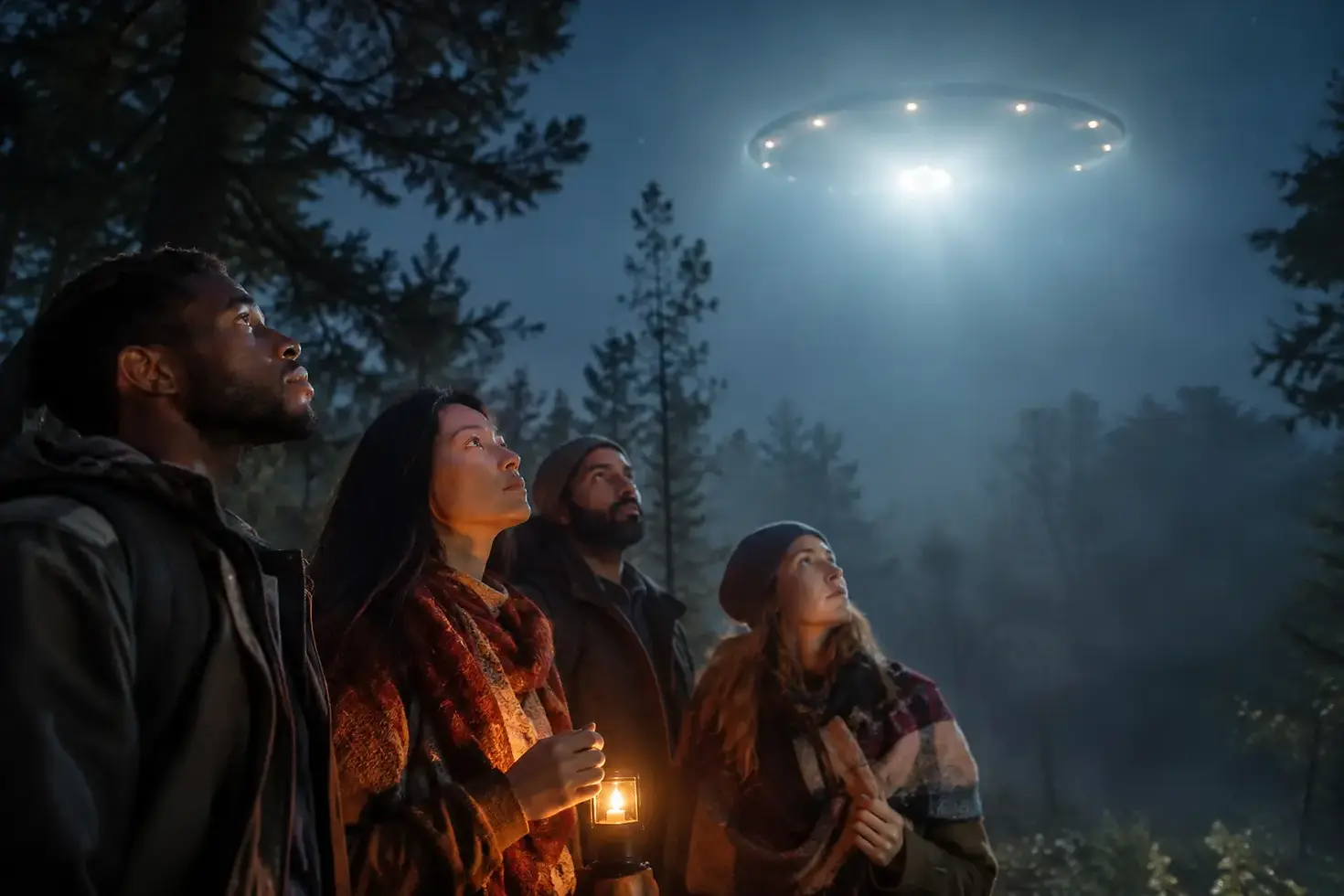
What Happened at the Rendlesham Forest Incident?

On a cold December night in 1980, U.S. military personnel stationed in England walked beyond the perimeter of RAF Woodbridge and into a mystery that still resists a clean explanation. The Rendlesham Forest incident is often called Britain’s Roswell, but that label can flatten something more interesting: a multi-night event involving trained witnesses, official documentation, physical-environment claims, and contradictions that demand discernment rather than blind belief.
For seekers, this is not merely a story about lights in the trees. It is a case study in how truth can appear fragmented - held in memory, field notes, institutional silence, and the uneasy space between what people report and what can be proved.
The nights that made Rendlesham impossible to ignore
The events began in the early hours of December 26, 1980, near RAF Woodbridge in Suffolk, England. Although the base was British, it was used by the United States Air Force, including units connected to NATO operations. Security personnel saw lights beyond the forest boundary and initially wondered whether an aircraft had come down.
Three airmen - John Burroughs, Jim Penniston, and Edward Cabansag - were sent to investigate. Their later accounts vary in detail, as witness recollections often do, but they agreed on the central point: they encountered unusual lights in Rendlesham Forest and believed they were observing something far outside an ordinary crash scene.
Penniston later described approaching a small, triangular craft that appeared to rest on or near the ground. He said it bore strange markings and had a dark, glasslike surface. Burroughs described intense lights and a disorienting encounter. Other personnel reported lights moving through the trees and across the sky.
That first night might have remained an obscure patrol report had it ended there. It did not. Two nights later, on December 28, Lieutenant Colonel Charles Halt, the deputy base commander, led a group into the forest to investigate the reported landing site.
Charles Halt’s memo and the audio recording
Halt’s involvement gave the case a level of official weight that few UAP reports possess. He made a voice recording during the expedition, a tense and imperfect document in which he and his men can be heard describing flashing lights, apparent movement, and objects in the sky. In the recording, Halt reports seeing a light that seemed to split into smaller lights and later describes a glowing object that appeared to send beams toward the ground.
Afterward, Halt wrote a memorandum dated January 13, 1981, addressed to the British Ministry of Defence. The document described three depressions in the ground, broken branches, and radiation readings taken at the site. It also stated that the witnesses saw a reddish, sunlike light moving through the trees and emitting what appeared to be particles.
This matters because the report was not assembled decades later by a distant storyteller. It came from a senior officer reporting unusual events connected to the personnel and grounds under his responsibility. That does not make every conclusion within the memo indisputable. It does make dismissal without examination intellectually lazy.
The recording and memo are evidence of what military personnel perceived, documented, and regarded as significant. They are not, by themselves, proof that an extraterrestrial craft landed in the forest. That distinction protects the integrity of the case.
What evidence survives - and what does not
The Rendlesham Forest incident sits at a cosmic crossroads between testimony and verification. Its strongest elements are the number of witnesses, the involvement of on-duty military personnel, Halt’s contemporaneous memo, and the surviving audio tape. The fact that reports continued across more than one night also gives the case a depth absent from a fleeting, single-witness sighting.
The physical evidence is more complicated. Witnesses and investigators discussed indentations in the ground, disturbed vegetation, and elevated radiation readings. Yet the readings reported were modest, and the chain of custody for environmental samples does not meet the standard a modern forensic investigation would demand. There is no publicly established piece of exotic material, no universally accepted radar record, and no clear photograph that settles the question.
Later testimony added further layers. Penniston spoke of a direct encounter with a craft and described receiving a sequence of binary code in his mind. Other witnesses reported missing time, unusual bodily effects, or long-term consequences. Such accounts may carry personal truth for those who lived them, but their later emergence requires careful handling. Memory can deepen, shift, and reorganize after a destabilizing event, especially when years of public debate surround it.
A disciplined researcher does not mock human testimony. Nor do they treat every remembered detail as equally verifiable. Both impulses are forms of complacency.
Could ordinary explanations account for it?
Skeptics have proposed several explanations. One of the most cited is the Orfordness Lighthouse, whose flashing beam could reportedly be seen from portions of the forest. Bright stars, meteors, distant aircraft, and the unfamiliar visual conditions of a dark woodland have also been offered as contributing factors. Some researchers have suggested that the men may have mistaken ordinary lights for extraordinary phenomena after entering a heightened state of alert.
These possibilities deserve to be considered. Night perception is notoriously unreliable. Distance, direction, color, and movement can be difficult to judge when trees, fog, fatigue, stress, and expectation interfere. A lighthouse can look uncanny through branches. A bright celestial body can seem to move when the observer has no stable reference point.
But one explanation does not necessarily account for every report. A lighthouse may help explain a stationary or repeating light seen from the forest. It does less to resolve why multiple trained personnel believed they encountered unusual activity at close range, why Halt felt compelled to document the matter formally, or why accounts from the event retained such force decades later.
The honest answer is not that Rendlesham has been conclusively explained or conclusively proven. The honest answer is that the record contains unresolved elements, uneven testimony, and enough official proximity to warrant continued attention.
Why the Rendlesham Forest incident still matters
The public conversation about UAPs often gets trapped between two tired camps. One treats every anomalous sighting as confirmation of a hidden cosmic presence. The other insists that uncertainty itself is evidence of nothing. Rendlesham offers a better path: take reports seriously, test claims carefully, and let unanswered questions remain unanswered until stronger evidence appears.
That approach is especially valuable for awakening souls who feel the pull of hidden history. Curiosity without discernment can become fantasy. Skepticism without openness can become another kind of prison. The work is to hold both intuition and evidence in the same field of attention.
There is also a human dimension that deserves respect. The people involved were not abstract characters in a documentary. They were service members operating within a military culture where reporting strange experiences could carry real professional and personal risk. Whether the cause was misidentification, a classified human technology, an unknown natural phenomenon, or something beyond current categories, the experience appears to have affected many witnesses profoundly.
How to approach the case with integrity
Begin with the primary record whenever possible: Halt’s memorandum and the audio recorded during his expedition. Then distinguish between what was documented near the time of the event and what entered the story years later. This does not mean later testimony is worthless. It means chronology matters.
Pay attention to areas of agreement. Multiple witnesses reported unusual lights in and above the forest. The base’s deputy commander investigated. A formal memo was written. Then identify the points where accounts diverge, especially descriptions of a landed craft, physical contact, radiation effects, and missing time.
Finally, resist the urge to force Rendlesham into a single answer. The desire for resolution is deeply human, but a mature seeker can live with a case that remains open. The unknown is not an invitation to abandon standards. It is an invitation to strengthen them.
The signal from Rendlesham is not that you must believe one extraordinary story. It is that your attention has value. Bring it to the evidence, honor the witnesses without surrendering discernment, and allow the mystery to sharpen your capacity for truth.



Comments